
Beyond summer heat: unraveling how prenatal heat stress affects performance across generations
This project examines how heat stress during pregnancy can affect not only a dairy cow’s calf, but also future generations of that calf’s descendants. Building on a unique, multi-year research herd, researchers will study daughters, granddaughters, and great-granddaughters of cows that experienced heat stress during late pregnancy. The team will investigate how prenatal heat exposure may leave lasting biological changes that influence growth, health, milk production, and longevity. By combining long-term animal records with advanced genetic and molecular analyses, the project aims to uncover why the effects of heat stress can persist years after the original exposure occurred.
For dairy farmers, the findings could reshape how heat stress is managed on farms. Previous research has already shown that calves exposed to heat stress before birth can have reduced growth, lower lifetime milk production, and shorter productive lives, with some of these impacts extending into subsequent generations. By better understanding these hidden, long-term consequences, the project will help farmers make more informed decisions about cooling strategies, breeding, and herd management. Ultimately, the research could lead to new approaches that improve animal welfare, strengthen herd resilience, protect milk production, and support the long-term sustainability of Wisconsin dairy farms as temperatures continue to rise.

Principal Investigator: Jimena Laporta
Jimena Laporta is an Associate Professor of Lactation Physiology in the Department of Animal and Dairy Sciences at UW–Madison. Her research focuses on how environmental stressors, particularly heat stress, affect dairy cattle health, productivity, and welfare across generations. Laporta leads internationally recognized studies on developmental programming, mammary gland biology, and the long-term impacts of prenatal heat stress on dairy cows and their offspring. Through her research and outreach efforts, she works to develop science-based strategies that help dairy producers improve herd resilience, animal well-being, and productivity in a changing climate.
jlaporta@wisc.edu
(608) 262-9705
Website
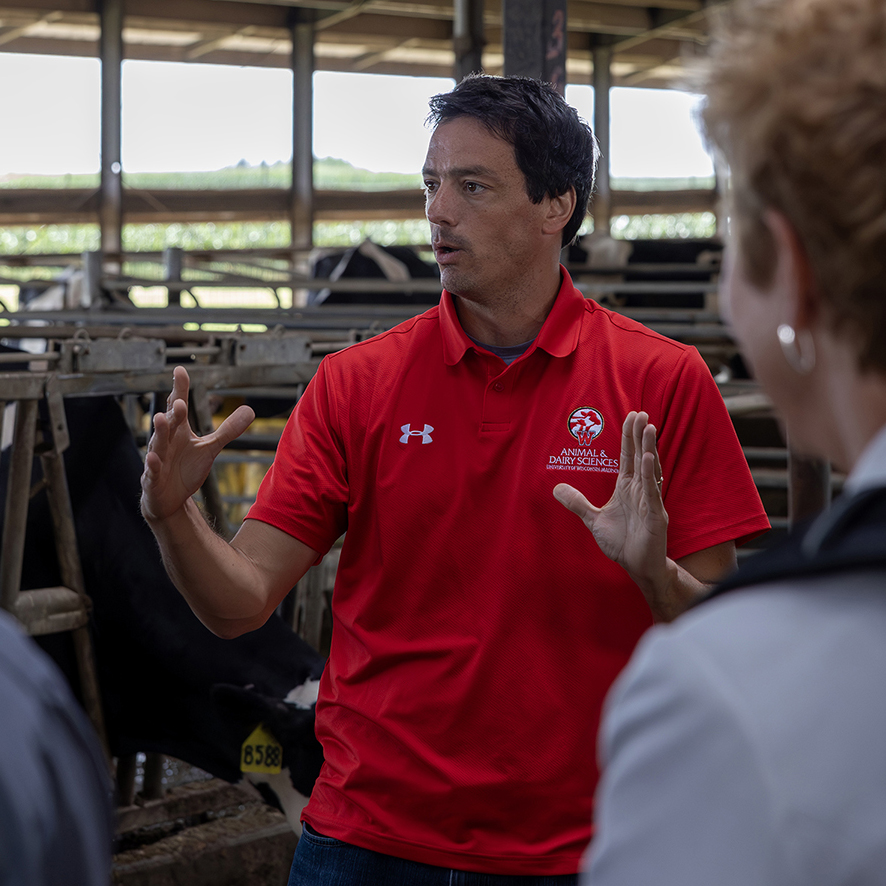
Co-Principal Investigator: Francisco Peñagaricano
Francisco Peñagaricano is an Associate Professor of Quantitative Genomics in the Department of Animal and Dairy Sciences at UW–Madison. His research integrates genomics, bioinformatics, statistics, and computational biology to better understand and improve economically important traits in dairy cattle. Peñagaricano specializes in using large-scale genomic and multi-omics data to study fertility, resilience, feed efficiency, environmental adaptation, and other traits critical to dairy farm sustainability. His work helps advance genetic and management tools that enable producers to raise healthier, more productive, and more resilient dairy herds
fpenagarican@wisc.edu
Website

Trainee: Rafaela Rodrigues dos Santos
Rafaela Rodrigues dos Santos is originally from Brazil, where she earned her Bachelor’s degree in Veterinary Medicine from the University of Brasília in 2017. She worked in the Brazilian beef industry for four years before moving to the United States to pursue her Ph.D. in One Health Sciences at Texas Tech University (2026). As a Graduate Research Assistant, her work has focused on extracellular vesicles, microRNAs, immunology, and animal health. Her research includes molecular and microbiome studies of colostrum-derived microRNAs and their effects on neonatal calves.
As a postdoctoral researcher, Rafaela will investigate how heat stress affects neonatal immune acquisition from colostrum, focusing on immunoglobulin transfer and other bioactive components. Her work will examine how heat stress alters colostrum quality and passive immunity in calves, as well as the role of factors such as microRNAs and extracellular vesicles in early-life immune development.
rodriguesdos@wisc.edu