
The University of Wisconsin–River Falls College of Agriculture, Food and Environmental Sciences (CAFES) recently awarded five faculty research fellowships to expand dairy-related research through the Dairy Innovation Hub initiative. The selected faculty will lead projects across the Hub’s four priority areas: stewarding land and water resources; enriching human health and nutrition; ensuring animal health and welfare; and growing farm businesses and communities.
Funded by a $7.8 million annual investment from the state of Wisconsin, the Hub brings together research and development efforts at UW–Madison, UW–Platteville, and UW–River Falls. Its goal is to keep Wisconsin’s $52.8 billion dairy industry globally competitive while promoting economic, environmental, and social sustainability. Since launching in 2019, the Hub has supported nearly 300 projects across the three campuses.
Faculty research fellowships provide temporary support for ongoing faculty, allowing them to focus on specific research projects. This support includes funding for related project expenses and helps ensure faculty have the time and flexibility needed to carry out research while maintaining their teaching responsibilities.
In addition to research outcomes, these projects create hands-on learning opportunities for students to work alongside faculty on field studies, laboratory analysis, and technology development, gaining experience with real-world data, modern equipment, and industry-relevant challenges.
The following UW–River Falls faculty fellows were selected for funding:
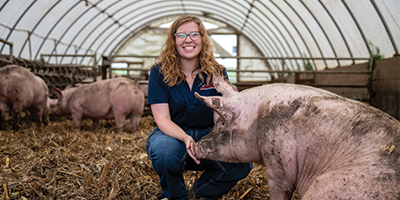
Karly Anderson, Humane Handling Institute and Kurt Vogel, Department of Animal and Food Science
“Captive bolt placement effects on tissue depth and thalamic damage in dairy cattle cadavers”
Anderson is a scientist and trainer at the Humane Handling Institute at UW–River Falls, and Vogel is a professor of livestock welfare and behavior and director of the Humane Handling Institute. Together, their work focuses on advancing livestock welfare through research, training, and industry engagement.
Project Summary:
Ensuring humane handling practices is a critical component of modern dairy farming. This project examines how the placement of captive bolt devices affects brain structures responsible for consciousness in dairy cattle. By studying tissue depth and the relationship to key regions such as the thalamus, the research aims to identify placement techniques that consistently result in rapid and effective unconsciousness.
The findings will provide science-based recommendations for veterinarians, farmers, and meat processors, improving the reliability and humaneness of stunning and euthanasia practices. By strengthening consistency in these procedures, the project supports both animal welfare outcomes and industry confidence in responsible livestock management.
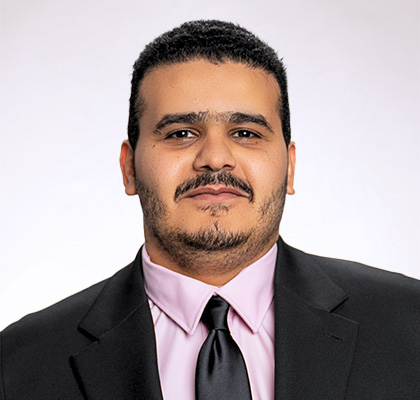
Magdy Abdullah Eissa, Department of Engineering and Engineering Technology
“Farm GPT (herd pilot): custom LLM advisor for dairy cow health monitoring with precision data for bovine management”
Eissa is an assistant professor specializing in mechatronics, intelligent control systems, and AI-driven technologies, with applications in precision agriculture and dairy systems.
Project Summary:
Modern dairy farms generate large amounts of data from sensors, monitoring systems, and precision tools—but turning that data into timely and actionable decisions remains a challenge. This project develops “Farm GPT,” an artificial intelligence–powered digital advisor that transforms complex farm data into clear, real-time guidance.
By using conversational AI, the system allows farmers and farm workers to ask questions and receive practical recommendations related to herd health, feeding, and management. This approach shifts dairy management from reacting to problems to preventing them. The technology has the potential to improve efficiency, strengthen animal welfare, and enhance farm profitability while making advanced tools more accessible and user-friendly.
Maria Jose Fuenzalida, Department of Animal and Food Science

“Molecular epidemiology of pathogens isolated from subclinical mastitis cases in Wisconsin dairy cows”
Fuenzalida is an assistant professor focused on dairy health, with research centered on mastitis, milk quality, and strategies to improve animal health and production.
Project Summary:
Subclinical mastitis is one of the most common and costly diseases in dairy herds, often reducing milk quality and production without visible symptoms. This project uses advanced DNA fingerprinting techniques to better understand how mastitis-causing bacteria spread within and between herds and how they respond to treatment.
By identifying patterns in transmission and antibiotic resistance, the research will help farmers and veterinarians make more informed decisions about prevention and treatment. The results will support improved herd health, reduced antibiotic use, and stronger long-term sustainability for dairy farms.
Mohammad Hasan Mobarok, Department of Agricultural Economics

“Export market concentration and dairy price risk: implications for Wisconsin farm businesses”
Mobarok is an assistant professor of agricultural economics whose research focuses on market dynamics, price analysis, and global trade in food systems.
Project Summary:
Dairy exports play a major role in supporting milk prices in Wisconsin, but these exports are increasingly concentrated in a small number of global markets. This project examines how that concentration affects price stability and financial risk for dairy farmers.
Using economic modeling and data analysis, the research will simulate how changes in global demand or trade conditions impact prices, revenues, and farm margins. By identifying high-risk scenarios, the project will provide farmers, dairy processors, and lenders with tools to better manage uncertainty and strengthen resilience in a changing global marketplace.
Ashani Thilakarathne and Holly Dolliver, Department of Plant and Earth Science

“Tracing the legacy: baseline assessment of potentially toxic trace metals under long-term manure application”
Thilakarathne is an assistant professor of soil science and conservation, and Dolliver is a professor of geology and soil science and department chair. Their work focuses on soil health, water quality, and sustainable agricultural systems.
Project Summary:
Manure is a valuable resource for dairy farms, but long-term application can also lead to the gradual buildup of trace metals in soil, crops, and water. This project examines how these elements accumulate over time and establishes baseline data to better understand potential risks.
The findings will help identify early warning signs of metal buildup and guide decisions related to manure management, feed inputs, and field use. By improving understanding of long-term soil processes, the project supports sustainable nutrient management, protects water quality, and helps maintain productivity across Wisconsin dairy systems.
Contact: Maria Woldt, Dairy Innovation Hub incoming director, (608) 265-4009, maria.woldt@wisc.edu