
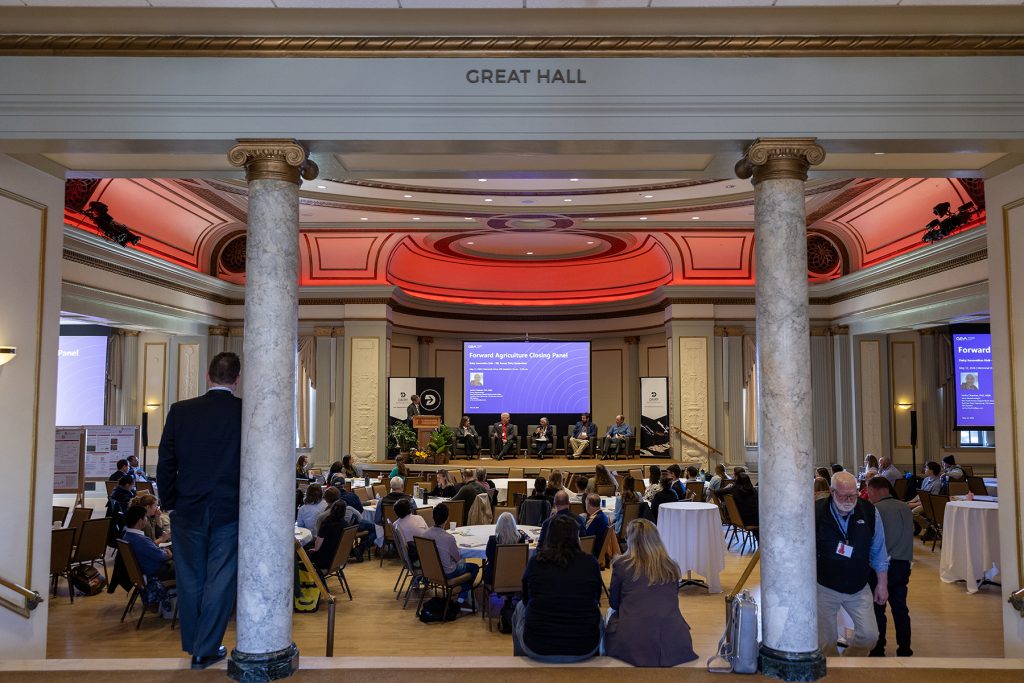
The afternoon plenary featured a panel of business partners and researchers from the Forward Agriculture initiative coordinated by WiSys . Photo by Nguyen Tran.
The Dairy Innovation Hub held its fifth annual Dairy Symposium on Tuesday, May 12, at the Memorial Union on the University of Wisconsin–Madison campus. During the day-long event, which drew over 200 attendees, scientists shared and discussed their Hub-funded work with researchers, students, campus colleagues, and others.
The Symposium is designed to highlight the Hub’s most advanced research, while encouraging participants to explore innovative ideas to ensure Wisconsin’s $52.8 billion dairy sector remains globally competitive while advancing economic, environmental, and social sustainability. Since its launch in 2019, the state-funded initiative has funded more than 260 projects and 23 faculty positions across UW–Madison, UW–Platteville and UW–River Falls.
“I would say that the Dairy Innovation Hub is a fantastic example of the Wisconsin Idea in action,” said Cynthia Czajkowski, associate vice chancellor for research at UW-Madison, during the Symposium’s opening remarks. “[It] delivers direct value to farmers, processors and citizens. It is bipartisan, highly accountable, and a model that could – and I believe, should – be replicated.”
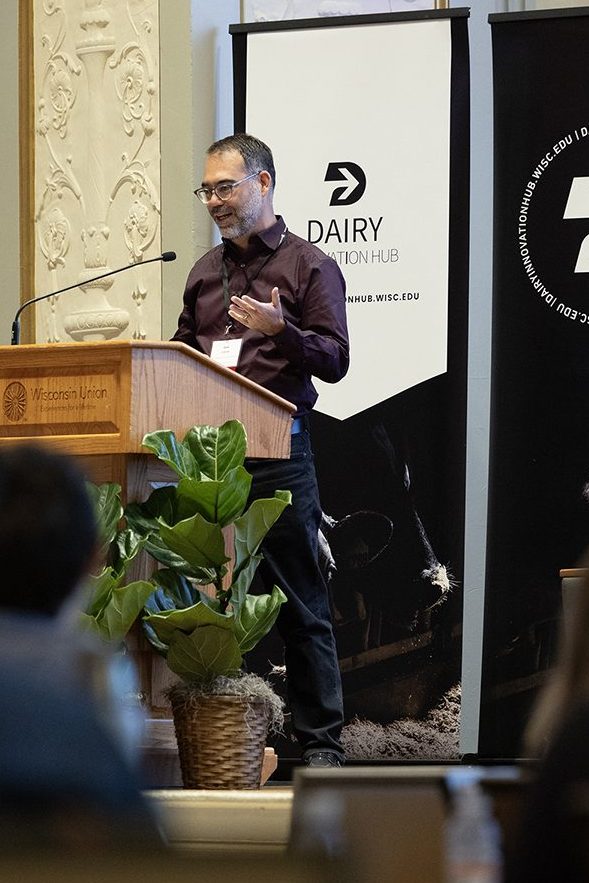
The symposium kicked off with a keynote talk by Kyle Cranmer, professor of physics and director of the Data Science Institute at UW– Madison. Cranmer gave a big-picture overview of the development of artificial intelligence over the decades, sharing insight into the current – and potential future – impact of data science on the dairy industry, agriculture and society.
“It was interesting to learn more about how artificial intelligence is currently operating in the world and then to look forward and consider how advanced technology could help the agriculture industry evolve and innovate. There is a valuable conversation to be had about how to harness the benefits of artificial intelligence, while avoiding potential pitfalls,” said Randy Romanski, Secretary of the Wisconsin Department of Agriculture, Trade, and Consumer Protection. “Wisconsin leads on dairy because of the innovation of our farmers, processors, and partners like the Dairy Innovation Hub. The Symposium was helpful to understand current trends and what may come next for Wisconsin dairy.”
The event included two morning and two afternoon breakout sessions, one for each of the Hub’s four priority areas: supporting human health and nutrition, stewarding land and water resources, ensuring animal health and welfare, and growing farm business and communities. During these sessions, researchers and graduate students presented on a wide range of topics – from identifying valuable new uses for dairy co-products, to exploring heat stress and methane emissions in dairy cattle, to understanding the preferences of milk consumers.
“The interdisciplinarity of the Hub is really evident in the poster sessions and the presentation sessions,” said Brad Bolling, professor in the UW–Madison Department of Food Science. “You can talk to anybody here today and learn something from them, something you don’t know. It’s so invigorating to get to learn from each other – and find inspiration for future projects and collaborations.”
The afternoon plenary session focused on “Forward Agriculture,” a statewide coalition led by WiSys, a nonprofit organization that serves as a technology transfer office for 11 Universities of Wisconsin campuses. Forward Ag started in 2023 with a $1M grant from the National Science Foundation, and since then has brought together over 400 stakeholders, including farmers, industry professionals, university scientists, government entities, and investors to shape Wisconsin’s agriculture‑tech research and development agenda. The overarching vision is to achieve agricultural resilience and food, security through economic, environmental and social innovations.
“Thanks to the State of Wisconsin, we’ve been able to fund some of the use-inspired research projects that were identified during the initial stakeholder engagement process – projects to help support sustainable agriculture,” said Bolling, who is involved in Forward Ag and was part of the plenary session panel. “It’s been exciting to see the strength of the collaborations we established and the momentum we have.”
A key objective of the Dairy Symposium is to foster the growth and development of the next generation of dairy researchers. To that end, more than 50 posters detailing student research projects were available throughout the day.
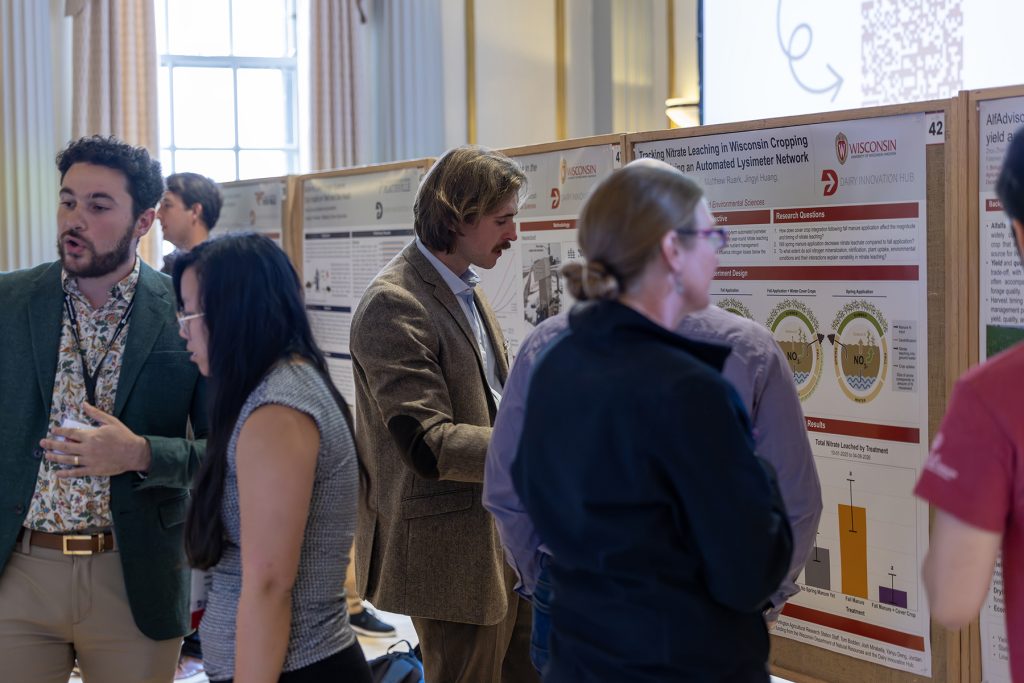
“The big-picture goal of my project is to look for ways to replace some nitrogen fertilizer use with manure-based options” says Oluwatoyin Ogayemi, a graduate student in the UW–Madison Department of Soil and Environmental Sciences, who presented a research poster titled “First-Year Nitrogen Availability from Processed Dairy Manure Products in Wisconsin Corn Production.” We are specifically evaluating liquid fractions from processed dairy manure, centrate, and pressate, which are high in plant-available nitrogen and low in phosphorus compared to unprocessed manure. This will hopefully save farmers money and prevent nitrogen leaching, but you need to apply the right material, at the right place, with the right timing. That’s what we are figuring out.”
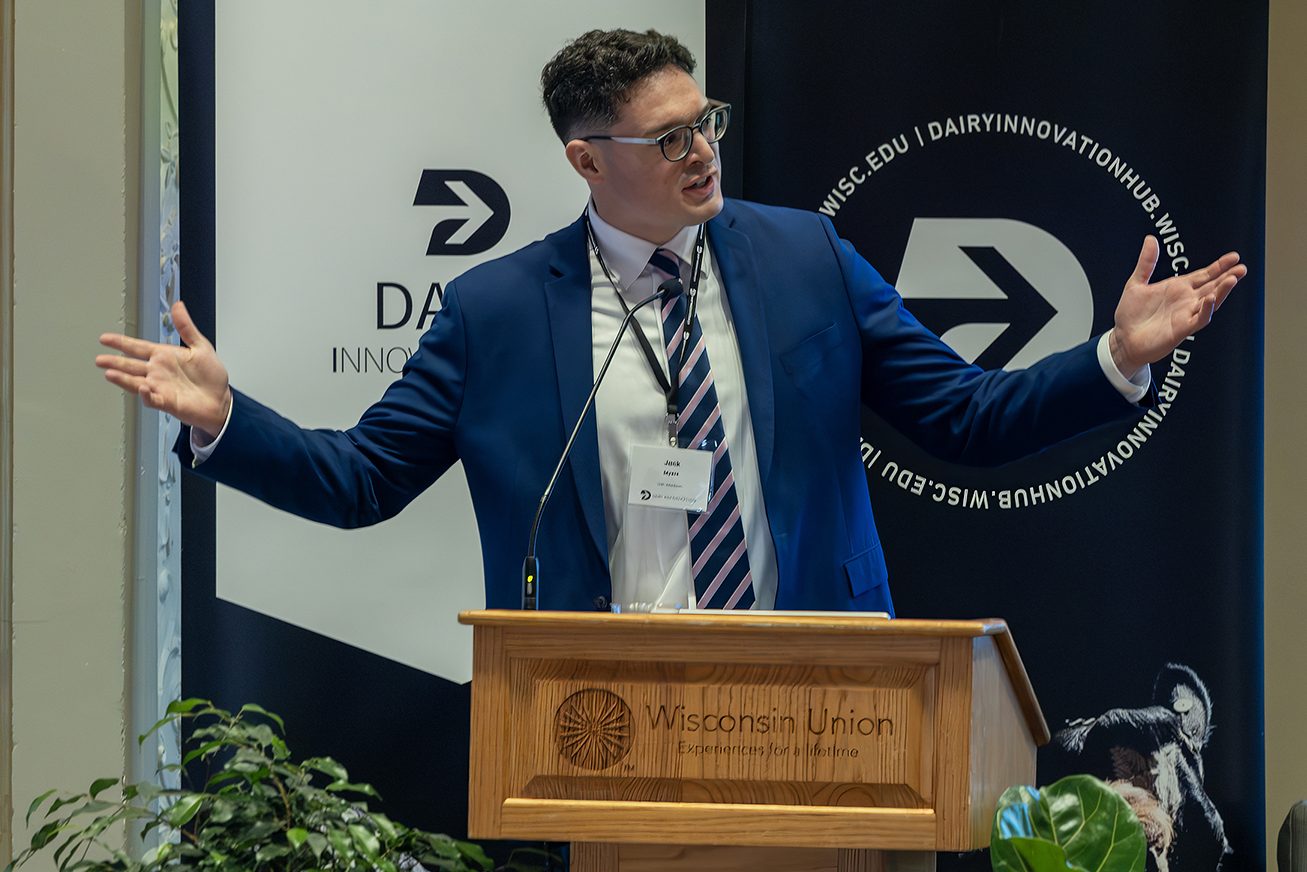
The event concluded with a student flash talk competition, followed by more poster viewing and networking. The winner of the competition was graduate student Jack S. Myers, from the Department of Animal and Dairy Sciences at UW–Madison, who presented his research examining how the 2025 tariffs and resulting trade disruptions affected U.S. dairy exports, particularly within key East Asian markets.
The Dairy Symposium is the academic-focused companion to the Hub’s public-focused Dairy Summit, which is held each fall.
Video recordings of all Dairy Symposium presentations are posted on the Dairy Innovation Hub’s YouTube channel.
Event photos suitable for media and public use are found in our event album
Contact: Maria Woldt, Dairy Innovation Hub incoming director, (608) 265-4009, maria.woldt@wisc.edu