
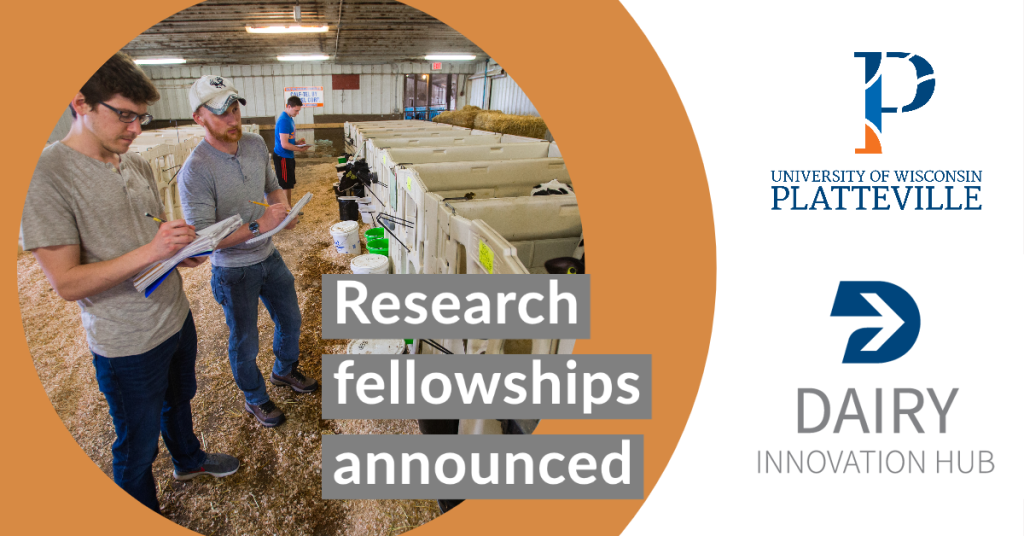
The University of Wisconsin–Platteville recently awarded five faculty research fellowships to increase dairy-related research capacity through the Dairy Innovation Hub initiative. Known as the Dairy Industry Impact Innovation Faculty Fellowships, or “DI3 faculty fellowships”, the selected faculty members will tackle research projects in the Hub’s four priority areas; stewarding land and water resources; enriching human health and nutrition; ensuring animal health and welfare; and growing farm business and communities.
Funded by a $7.8 million annual investment from the state of Wisconsin, the Hub brings together research and development efforts at UW–Madison, UW–Platteville, and UW–River Falls. Its goal is to keep Wisconsin’s $52.8 billion dairy industry globally competitive while promoting economic, environmental, and social sustainability. Since launching in 2019, the Hub has supported nearly 300 projects across the three campuses.
These fellowships provide faculty with dedicated time and resources to focus on targeted research while continuing their teaching responsibilities. The projects also create hands-on learning opportunities for students through fieldwork, lab analysis, and applied technology development.
The following UW–Platteville faculty fellows were selected for funding:
Kelvin Amon, School of Agriculture

“Beyond feed: an alternative safety net for Midwest dairies through non-feed cost reduction”
Amon is an assistant professor whose work focuses on economic resilience in dairy systems, particularly for small- and mid-sized farms.
Project Summary:
Rising non-feed costs—such as labor, equipment, and overhead—continue to strain dairy farms, even when milk prices are stable. Current safety net programs focus largely on feed, leaving many farms unable to cover total costs.
This project will develop a farmer-informed safety net that better reflects the full cost of dairy production. By incorporating farmer input, the work aims to inform policy solutions that improve profitability, support sustainability, and help keep more farms viable.
Kelvin Amon and Rich Crow, School of Agriculture

“Short-stature corn as a sustainable alternative for silage production: agronomic efficiency and economic feasibility”
Amon collaborates with Rich Crow, an assistant professor specializing in agronomy and agricultural technology, on this project.
Project Summary:
With brown midrib (bm3) corn expected to be phased out by 2030, dairy farmers need reliable alternatives for high-quality silage. Short-stature corn shows promise, offering comparable nutrition along with benefits such as improved standability and harvest efficiency.
Field trials in Wisconsin will compare short-stature and bm3 hybrids across yield, forage quality, and economic return. The results will provide practical, local, farm-scale guidance to help farmers maintain productivity and profitability during this transition.
Marcia Harr Bailey, School of Business

“The future of dairy entrepreneurship through the PYLot project”
Bailey is an associate professor of business and entrepreneurship focused on experiential learning and innovation.
Project Summary:
Wisconsin has lost nearly 70 percent of its dairy farms over the past 25 years, even as milk production has remained strong due to advances in technology and efficiency. While this reflects the industry’s resilience, it also highlights growing financial pressure on dairy farms. To stay viable, dairy farmers are increasingly exploring new revenue streams, technologies, and business models. At the same time, many young people entering the industry lack exposure to entrepreneurship and innovation skills that can help them identify and develop new opportunities.
The PYLot (Prototype Your Life) pilot connects students with dairy farmers through hands-on, app-based learning. Students develop innovation skills while tackling real farm challenges. Outcomes include new business ideas, a shared repository of diversification strategies, and insights to expand entrepreneurship across dairy communities.
James Hampton, School of Agriculture

“Protein and energy metabolites as predictors of postpartum reproductive recovery in dairy cows”
Hampton is a professor of animal, dairy, and veterinary sciences specializing in cattle physiology and reproduction.
Project Summary:
During the transition period after calving, dairy cows often experience delayed reproductive recovery due to nutritional demands. While energy balance is well studied, the role of protein loss is less understood.
This study will track both protein and energy indicators in dairy cows alongside reproductive data to better understand how these factors influence recovery after calving. By identifying whether protein status is an important predictor, the research could open the door to new, more precise feeding and management strategies that improve fertility and reduce economic losses.
Zifan Wan, School of Agriculture

“Plasma treatment of condensate of whey (COW) water for sustainable dairy cleaning applications: a bench-scale study”
Wan is an assistant professor focused on applying non-thermal technologies to improve food safety and sustainability.
Project Summary:
Dairy processing requires large volumes of water, especially for cleaning. This project explores reusing condensate of whey (COW) water, a byproduct typically discarded despite being only lightly contaminated.
Researchers will test atmospheric cold plasma, which can safely kill microbes and enhance water with natural antimicrobial properties, making it suitable for reuse in cleaning processes. If successful, the approach could reduce water use, lower costs, and turn a waste stream into a valuable resource.
Contact: Maria Woldt, Dairy Innovation Hub director, (608) 265-4009, maria.woldt@wisc.edu