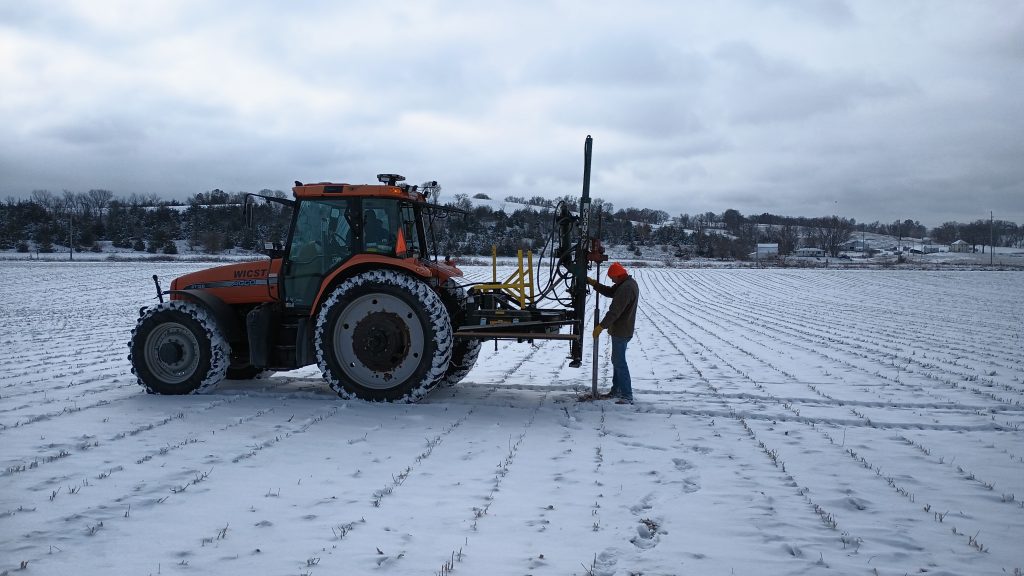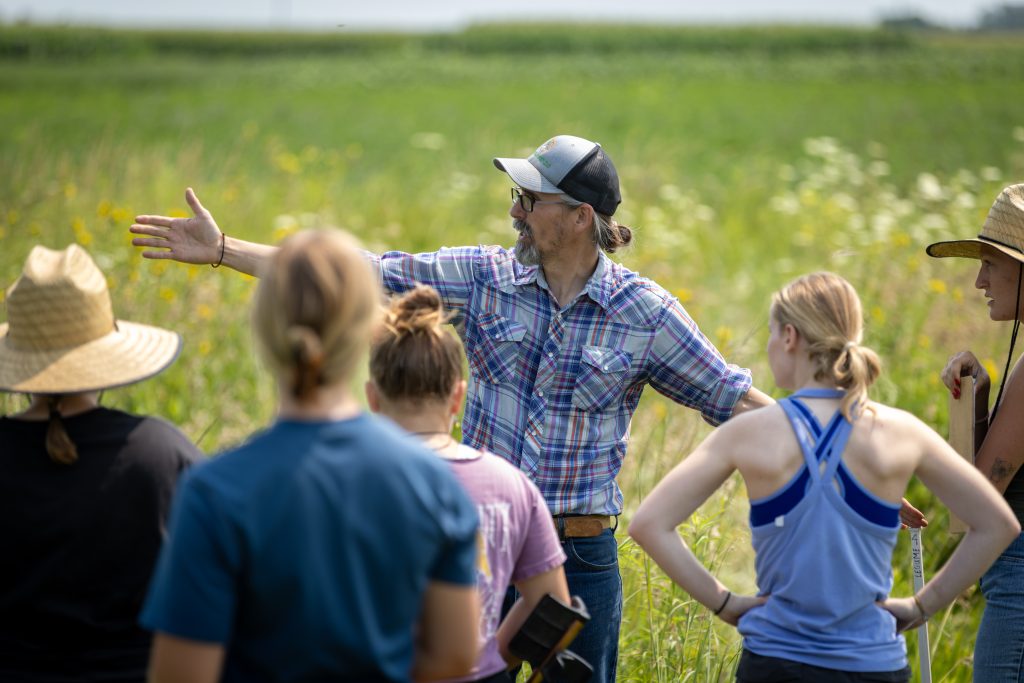
Sanford’s research also focuses on Ecological intensification, which works with nature to grow crops more sustainably. Practices like cover crops, reduced tillage, and crop-livestock integration can improve soil health, boost yields, and reduce reliance on synthetic fertilizers. Photos contributed.
Assistant Professor | Soil and Environmental Sciences UW–Madison | start date August 2024
Where did you grow up?
I am an army “brat”! I was born in Okinawa, Japan, and moved a lot while growing up. Between Japan, western Europe, and the US, I lived in nine different cities before college. Many summers were spent on my grandparent’s dairy farm in Viola, WI. I’ve always considered Viola my “hometown” because of deep family roots.
What is your educational/professional background, including your previous position?
I did my undergraduate studies in field botany at New College of Florida in Sarasota. After working on a few farms, I earned my MS and PhD in the Department of Agronomy here at UW–Madison. Between 2012 and 2024, I worked as a research scientist in Randy Jackson’s Grassland Ecology Lab.
What is your field of research, and how did you get into it?
I study agricultural systems and how our management of them affects critical ecosystem services like soil carbon sequestration and climate resilience. I’ve always loved plants and farming. While working on farms in my early 20s, I learned about the interconnectedness of crops, soils, water, and climate. I realized that agriculture had the potential to alleviate or exacerbate many of the wicked problems facing society in the 21st century. I wanted to be part of the solution; the rest is history.
What are the main goals of your current research and outreach programs?
A lot of my work approaches agricultural systems through the lens of ecological intensification. The object is not to maximize a single outcome (yield, for example) but to optimize several ecosystem services (carbon sequestration, water quality, soil structure, yield, profitability).
What was your first visit to campus like?
Wow, that was a long time ago. I met the late Dr. Josh Posner (my master’s & PhD advisor) and Janet Hedtcke (current superintendent at West Madison ARS) for ice cream at Babcock in September of 2004. It was just before my first semester of graduate school. I remember loving the school, laughing at Josh’s jokes, thinking Janet was super cool, and wondering if I could make it!
What’s one thing you hope students who take a class with you will come away with?
A sense of wonder and excitement about soils and agroecosystems. The world is a complex and beautiful place. Science is amazing, soils are amazing, crops are amazing, and people are odd but also amazing! If you don’t walk away from your classes inspired and excited about your studies, you should think hard about what you are doing.
Do you feel your work relates in any way to the Wisconsin Idea?
Absolutely! My research aims to serve all members of our community by building agricultural systems that stabilize carbon, clean our water, protect our soils, provide resilience to a changing climate, and help put food on the table (literally and figuratively). At a more granular level, I am the director of the 60-acre, 36-year-old Wisconsin Integrated Cropping Systems Trial (WICST). This long-term experiment serves as a land lab for community engagement, a classroom for undergraduate and graduate students, and an invaluable hub for national and international scholarship.
What’s something interesting about your area of expertise that most people don’t know?
It doesn’t take much for me to wax poetic about soils and the importance of soil organic carbon to the global carbon cycle (“Did you know that there is more organic carbon in our soils than in the atmosphere and all above ground organisms combined!”). It’s a powerful reminder of how much impact lies beneath our feet.
What are your hobbies and other interests?
I love to sail, play music with friends (guitar, mandolin, fiddle), run, and hike.